Give Every Drawer a Job You Can Maintain
A tidy dresser is useful when finding and putting away clothes feels straightforward on an ordinary busy day. Perfect rows are optional; a system that survives laundry day is not. The most effective drawer organization starts with the clothes you actually wear, the way you prefer to fold them, and the heights you can reach comfortably. It then gives each category enough space to be seen and returned without pushing neighboring items aside. Before buying dividers or changing every fold, notice where your current arrangement breaks down. Missing socks, buried shirts, and a drawer that never closes properly each point to a different problem, and a good solution should address that particular friction.
A: No. Choose visible rows or shallow stacks according to the garment and drawer.
A: Only if the session is manageable; a drawer or category at a time can work.
A: It may not have been planned for the complete clean wardrobe.
A: No. Use the fewest useful boundaries and leave flexibility for ordinary variation.
A: Give unresolved pieces a limited temporary home rather than mixing them into the daily supply.
A: Agree on clear ownership or category zones that both users can understand.
A: Review its arrangement, contents, and storage location rather than repeatedly compressing it.
A: When it improves everyday access without hiding garments still regularly needed.
A: A functional system may need only small resets unless the wardrobe or routine changes.
A: You can find and return clothing easily through a normal week.
Empty a Manageable Area and See What Is There
Choose a session that you can finish without leaving the bedroom unusable. If emptying the whole dresser would create an overwhelming pile, work through one drawer or one clothing category at a time. Set aside a clear surface for sorting and keep the items grouped while you work. The goal is an accurate view of the contents, not a dramatic mess that makes completing the task harder.
Separate clothes that belong in the dresser from items that arrived there because no other home was obvious. Paperwork, spare cables, and unrelated accessories can quietly consume useful clothing space. Decide where those belongings should live before returning them by habit. If the dresser genuinely needs a small mixed-use drawer, define that role clearly and give it appropriate limits.
Remove items that are ready for laundering or need attention, and make an actual plan for repairs or decisions that cannot happen immediately. A permanent pile of unresolved clothes can recreate the same congestion beside the dresser. Use a contained temporary location and a realistic next action. Organizing becomes easier when every item does not have to be reconsidered each time you open a drawer.
Sort by the Way You Get Dressed
Group clothing into categories that match your habits. Everyday shirts, exercise clothes, underwear, and sleepwear are useful possibilities, but the right divisions depend on your wardrobe. Too many tiny categories can make resetting the dresser tedious. Too few can leave a broad mixed drawer in which individual items disappear. Begin with simple groups and divide only where access actually improves.
Consider whether items are selected together. Workout tops and bottoms may be convenient in the same area, while work clothing may belong in a separate zone. Avoid duplicating a category in several drawers unless the division has a clear purpose. A system is easier to maintain when you know where a garment belongs without having to weigh several equally plausible locations.
Assign Daily Items to Comfortable Heights
Put the most frequently used categories in drawers that are easy for the user to reach and see into. A very high drawer can hide its back edge, while a low drawer may require more bending. Use the actual person’s reach rather than a universal top-to-bottom hierarchy. Occasionally used belongings can take the less convenient positions when that arrangement remains comfortable and safe.
For shared dressers, agree on ownership and category boundaries before filling drawers. Separate columns or clearly defined compartments may reduce confusion. The division does not need to be perfectly equal if the wardrobes differ in size. It should be understandable to both people, including anyone who regularly puts clean laundry away.
Keep heavier contents within the furniture’s stated loading guidance, and follow all assembly and restraint instructions. Organization does not replace appropriate furniture installation. Avoid habits that encourage climbing or using open drawers as steps. A storage layout should make needed items more accessible while supporting the intended use of the cabinet.
Choose Folding That Fits the Drawer
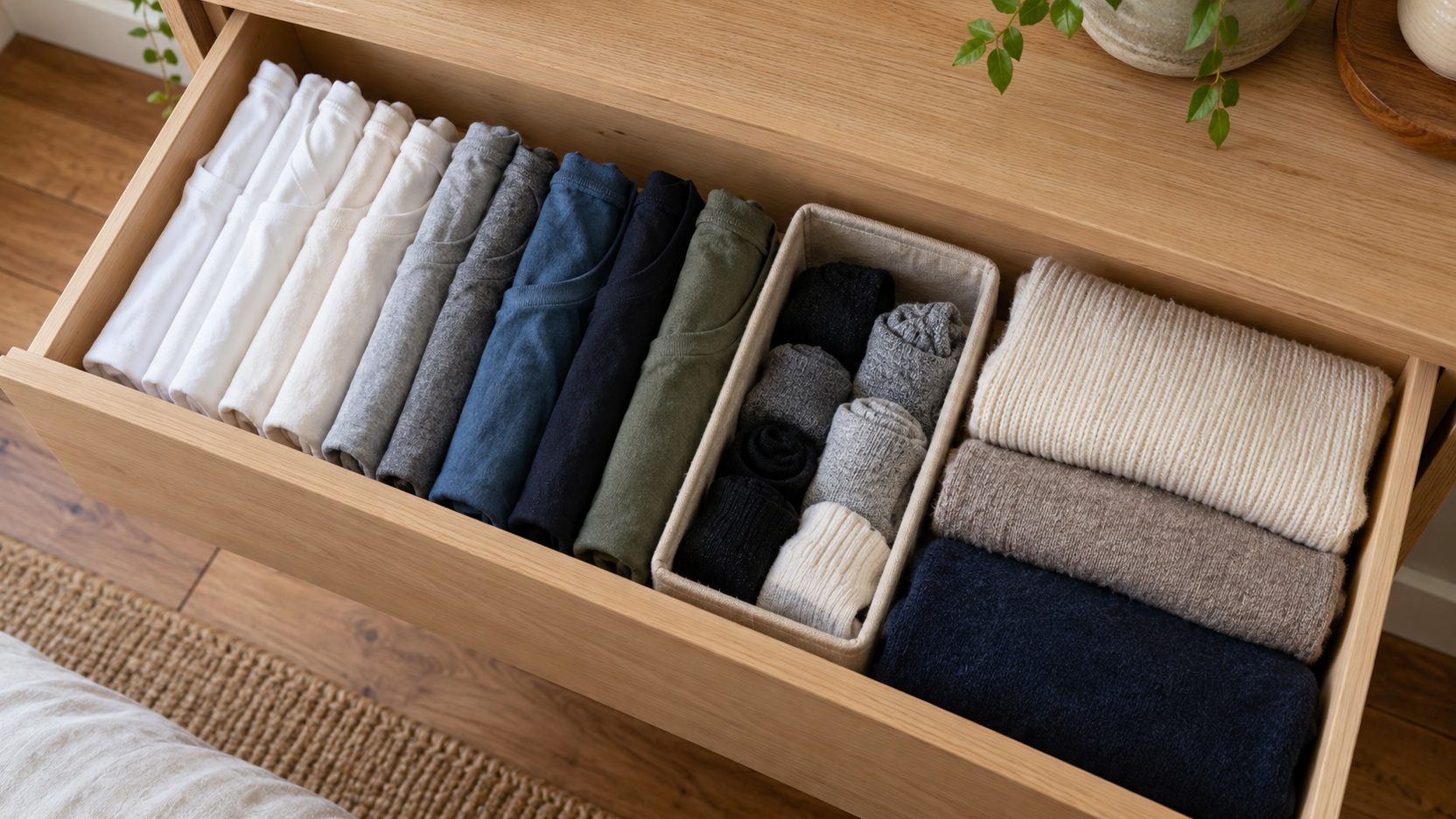
Start with the drawer’s internal width, depth, and height. A folded shape that looks tidy on a table may waste space or bunch against the drawer above when placed inside. Test a few representative garments before refolding an entire category. The simplest useful fold is one you can repeat easily and that leaves the clothing visible enough to select. Vertical rows can help you see several items at once, while shallow stacks may suit other garments or personal preferences. Neither method needs to become a rule for every drawer. A soft knit that will not hold a rigid fold may work better in a relaxed stack. Choose the arrangement around the material and the way you take clothes out.
Use Dividers to Support a Clear Boundary
Dividers are useful when categories drift into one another or small items spread through a large compartment. Measure before buying, including any taper, hardware intrusion, or uneven interior shape. An organizer that fits the advertised drawer width may not fit the usable space inside. Begin with the minimum number of divisions needed to make the contents easier to understand.
Allow each category some flexibility. A tightly fitted system with one tiny cell per item can be satisfying to arrange yet difficult to use when the laundry balance changes. Adjustable dividers or a few simple containers may accommodate ordinary variation more naturally. The organizer should assist the routine rather than demand exact counts and identical folds.
Check that the chosen dividers are suitable for the drawer and do not interfere with closing or damage its surfaces. Heavy containers add to the total load. Tall edges may snag soft clothing or make access awkward. Evaluate the complete filled drawer instead of judging the organizer on its own.
Handle Socks and Small Accessories Without Overengineering
Small belongings often benefit from a bounded area because they can disappear beneath larger clothes. Group socks in a way that makes pairs easy to recognize and return, without using a method that stretches them unnecessarily. Keep frequently used accessories separate from occasional pieces where that distinction helps. A modest tray or compartment may solve the problem without an elaborate sorting system.
Review the collection when a small-item drawer is constantly full. Unmatched socks, unused accessories, and items kept for uncertain reasons can occupy space intended for the current routine. Give unresolved pieces a limited temporary home rather than mixing them back into the daily supply. This makes selection clearer without requiring an immediate decision about every object.
Leave Enough Space for Clothes to Move
A drawer needs working room as well as storage volume. If removing one shirt pulls several others out of place, the contents may be compressed too tightly or folded into an unsuitable arrangement. Try a small reduction in the drawer’s contents before buying more containers. Better visibility and easier return can make slightly less storage more effective in practice.
Check the drawer with all regular clothing accounted for. A system arranged while many items are in the wash can look successful until laundry day. Include that full collection in the capacity test and leave reasonable room for normal changes. The aim is not an empty-looking drawer, but one that can handle an ordinary week without becoming difficult to close.
If the category still does not fit, decide whether it needs another storage location, a different division, or a review of the clothes retained. Repeatedly forcing the drawer shut is not an organization method. It may also put unnecessary strain on the furniture. Resolve the mismatch at the category level instead of accepting friction as part of the routine.
Keep Seasonal Rotation Simple
Rotate clothing only when it makes the everyday dresser easier to use. In some climates, a mix of light and warm layers remains useful year-round, so a strict seasonal split may be inconvenient. Base the division on actual use rather than the calendar alone. Keep transitional pieces accessible if they are regularly needed between weather changes.
Clean and dry clothes appropriately before placing them in longer-term storage, and choose a location and container suited to the material and conditions. Record the contents clearly enough to find them again. Do not create a hidden overflow that is never reviewed. Seasonal storage should have a return routine as well as a departure routine.
Connect the Dresser to Laundry Day
The easiest organization system has a clear path from clean laundry to the correct drawer. Keep category names and positions intuitive enough that putting clothes away does not require reconstructing a display. If a particular fold slows the process so much that clothes remain in a basket, simplify it. A functional reset is more valuable than a more elaborate method that rarely happens.
Put clothes away in manageable groups and return them to the same general area each time. A quick visual check can catch a category starting to crowd another before the whole drawer deteriorates. You do not need to refold everything during every reset. Correct the few changes that affect access and leave the rest usable.
Where another household member helps, make the system understandable without constant explanation. A discreet label may be useful inside a shared drawer, although labels are unnecessary if the arrangement is already obvious. Agree on the basic divisions and allow some personal variation within them. The dresser should support the household rather than turn laundry into a test of one person’s exact method.
Review the Drawer That Keeps Failing
A recurring messy drawer contains information about the mismatch. Perhaps it holds too many different categories, its contents are used more frequently than expected, or the chosen organizer blocks a natural movement. Observe what gets pushed aside and what stays buried. Make one change at a time so you can see whether it improves the routine.
Be willing to move a category even after carefully arranging it. A drawer plan is a working hypothesis rather than a permanent commitment. If socks belong more comfortably in another compartment or exercise clothes need a larger area, adjust the boundary. Maintenance becomes easier when the storage follows real behavior instead of asking daily behavior to fit a decorative plan.
Use a Small Reset to Keep the System Useful
At a convenient interval, check for clothing that no longer belongs in its current category and for objects that have drifted into the dresser. Remove the obvious mismatches, straighten any divisions that affect access, and stop when the drawers work again. A brief functional reset can prevent the need for repeated complete reorganizations. It is also easier to fit into a normal week.
Keep an eye on changes in the wardrobe itself. A new activity, different work clothing, or a shift in climate needs can alter which drawers deserve the best positions. Reassign space when those changes are real rather than adding a new organizer for every purchase. The most durable system remains flexible while keeping its basic logic easy to understand.
Try a concrete drawer arrangement before purchasing inserts. One shallow drawer might hold socks on the left and underwear on the right, separated by a single suitable divider. A second drawer can hold two loose rows of shirts with their distinguishing edges visible. Knitwear may sit in a third drawer as short stacks rather than being forced into the shirt fold. When clean clothes return, each category has one obvious destination. If a stack repeatedly collapses, lower that stack or change its position instead of rebuilding the entire dresser around a fashionable folding method.